
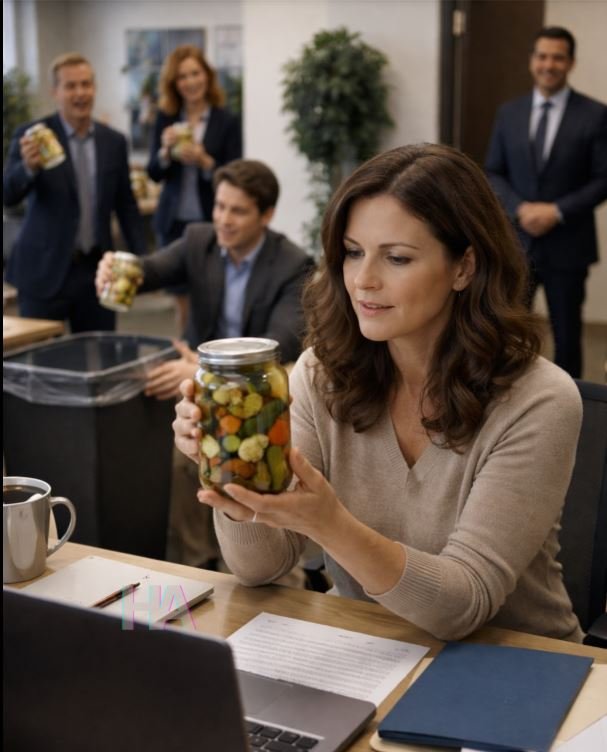
EVERYONE MOCKED THE PICKLE JARS MY BOSS GAVE US… I TOOK THEM HOME OUT OF PITY, AND ONE OF THEM EXPOSED A SECRET THAT COULD DESTROY THE ENTIRE COMPANY
The atmosphere at Vanguard Logistics had turned sour long before the annual holiday “bonus” meeting. Rumors of a massive merger had been circulating for months, and the senior analysts were expecting five-figure checks. Instead, our CEO, Mr. Henderson, stood at the front of the conference room with a strained, oily smile, gesturing toward a stack of cardboard boxes.
“Times are lean, team,” he announced, his voice booming with fake enthusiasm. “But we are a family. And families share the harvest. This year, I’m giving you something from my private estate: artisanal, hand-packed pickles.”
The silence that followed was deafening. One by one, my colleagues—men and women who had billed eighty-hour weeks—stepped forward to receive a glass jar filled with vinegar and vegetables. As soon as Henderson left the room, the mocking began.
“Is he serious?” Greg, the lead auditor, laughed, immediately dropping his jar into the trash can by the door. “I’m an Ivy League graduate, and I’m being paid in cucumbers.”
Others followed suit, leaving their jars on desks or tossing them in the bin as they stormed out to call recruiters. I felt a strange pang of pity. Not for Henderson—who I knew owned three vacation homes—but for the sheer absurdity of it. I scooped up four of the abandoned jars, tucked them into my bag, and headed home.
That night, as I sat in my small kitchen, I reached for one of the jars to accompany my lackluster dinner. It was a heavy, quart-sized Mason jar, the lid sealed with wax. As I struggled to twist it open, I noticed something odd. The vegetables weren’t packed tightly. There was a hollow space in the center, obscured by large sprigs of dill and thick slices of garlic.
I finally pried the lid off, but instead of the sharp scent of brine, I smelled something metallic. I poured the contents into a colander in the sink.
A small, waterproof plastic canister tumbled out from between the pickles.
My hands shook as I dried it off and popped the cap. Inside was a high-capacity encrypted flash drive and a single, hand-written note: “For the one who doesn’t throw away what they don’t understand. Look at the ‘Project Verdant’ folder.”
I plugged the drive into my laptop. My screen was immediately flooded with internal ledgers, offshore bank statements, and email chains. “Project Verdant” wasn’t a merger; it was a sophisticated embezzlement scheme. Henderson wasn’t struggling to pay bonuses—he was systematically draining the company’s pension fund into a private shell company in the Cayman Islands before the merger could trigger a mandatory audit.
The pickles weren’t a gift. They were a desperate, paranoid test. Henderson knew there was a whistleblower in the office, and he had distributed these “bonuses” to see who would keep them and who would discard them. He assumed the “loyal” employees would keep the gift, and he could then use the drives to implicate whoever came forward as a co-conspirator, claiming they had stolen the data from his “private estate.”
But he had miscalculated. He expected greed or loyalty; he didn’t expect pity.
The next morning, I didn’t go to my cubicle. I went to the Federal Building.
By noon, three black SUVs pulled up to Vanguard Logistics. As FBI agents swarmed the executive floor, the colleagues who had mocked the “pickle girl” watched in stunned silence as I walked out of Henderson’s office, flanked by investigators.
Mr. Henderson was led out in handcuffs, his face the color of the very vegetables he had used to hide his crimes. The company collapsed by nightfall, but because of the data on that drive, the pension fund was frozen and eventually restored.
I never did find out if the pickles were actually any good. I was too busy using my whistleblower reward to start my own firm—one where the bonuses are paid in currency, and the only thing we keep in jars is our integrity.