
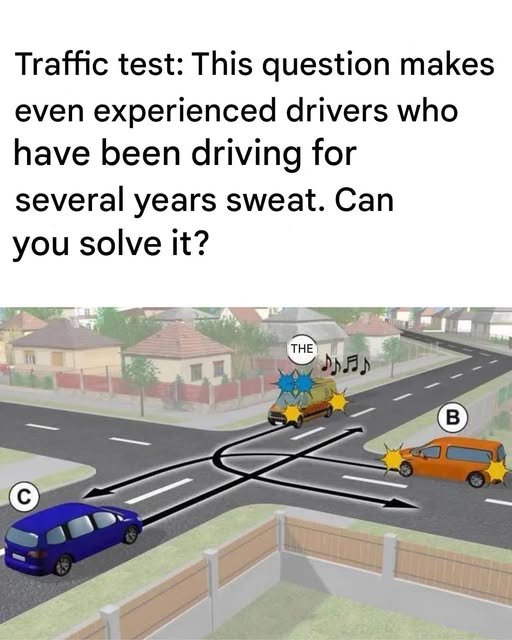
Traffic test: This question makes even experienced drivers who have been driving for several years sweat. Can you solve it?
The Intersection Headache: Who Goes First?
It looks like a simple three-way intersection, but this “Traffic Test” has gone viral for one reason: it’s a total trap. Even drivers with decades of experience find themselves arguing over the order of operations for Cars A, B, and C.
Let’s break down the chaos and find the actual solution.
The Situation
We have three vehicles at an unmarked T-junction:
- Car A (The Van): Moving straight through the intersection.
- Car B (Orange Car): Turning left across the path of Car A.
- Car C (Blue Car): Turning left across the path of Car B.
The Rule of Law: Who Has Priority?
Since there are no stop signs or lights visible, we have to rely on the Universal Rules of the Road. However, these rules can vary slightly by country, which is where the “sweating” starts.
1. The “Right Hand” Rule
In many countries (and most of Europe/US/Africa), when an intersection is completely unmarked, the driver on the right has the priority.
- Car C has no one to their right.
- Car B has Car C to their right.
- Car A has Car B to their right.
2. Turning vs. Straight
Generally, vehicles going straight have priority over those turning across traffic.
- This would give Car A the advantage over Car B.
3. The Left-Turn Conflict
If Car B and Car C are both turning left, they both have to cross a lane of oncoming traffic.
The Logical Solution (The Order)
If we apply the standard priority rules for an unmarked T-junction, the order should technically be:
- Car C (Blue): It is on the “main” road and isn’t blocked by anyone to its right. It clears the intersection first.
- Car A (Van): Once Car C is gone, the path is clear for the Van to proceed straight.
- Car B (Orange): Because it is making a left turn across the entire intersection, it must wait for both A and C to pass before completing its move.
Final Order: C -> A -> B
Why People Are Arguing
The reason this post gets thousands of comments is that it’s poorly designed on purpose.
- The “Main Road” Trap: Some argue that the horizontal road is the “major” road, meaning A and B should go before C.
- The “Straight” Logic: Others argue that Car A should go first because it isn’t turning, regardless of where the other cars are.
- Regional Differences: In some jurisdictions, the vehicle on the terminating road (the bottom of the “T”) must yield to all traffic on the through-road, which would put Car C last.